Your bag is empty
Don't miss out on great deals! Start shopping or Sign in to view products added.
Shop What's New Sign in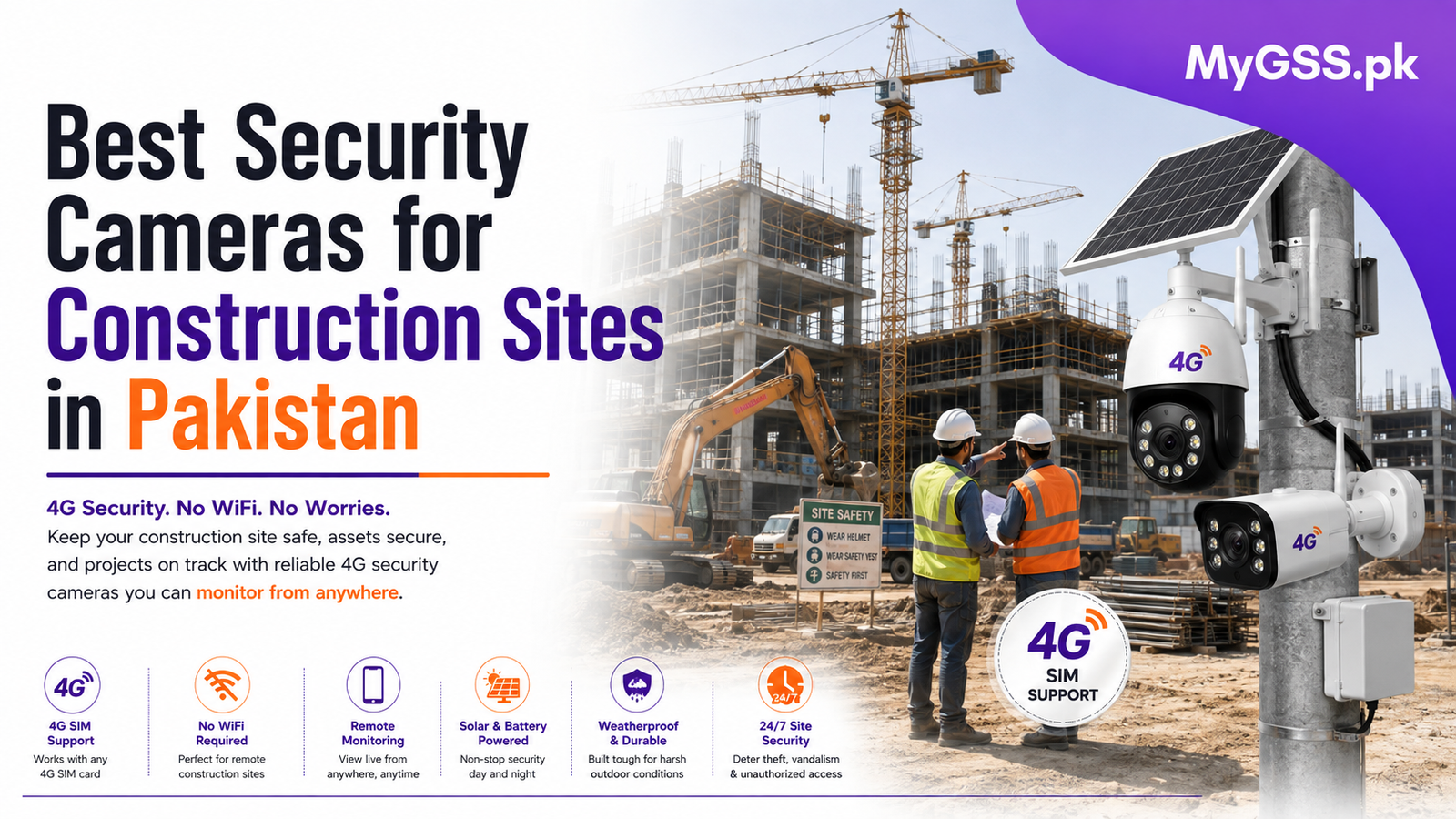
Construction sites present a genuinely different security challenge than a home or shop. There’s often no permanent electricity, no WiFi, valuable material and equipment left overnight, a constantly changing layout as work progresses, and a real risk of theft when the site is unattended. A security camera built for a living room simply isn’t built for this environment.
This guide covers the three camera types that actually work for construction sites — solar 4G cameras, outdoor dual lens cameras, and rugged bullet cameras — and real, in-stock options for each, currently available at MyGSS.pk.
Before comparing specific models, it helps to know what to prioritize:
This is the single most important camera type for a construction site specifically. A solar 4G camera runs entirely on battery and solar power, connecting through a SIM card rather than WiFi — meaning it works from day one, before any electricity connection exists on site.
A dependable, budget-accessible entry point into off-grid site monitoring. It combines solar charging, battery backup, and 4G SIM connectivity, so it works entirely independent of both WiFi and grid electricity. Customer reviews specifically mention it holding up well on remote and unfinished properties.
Best for: Sites in the early stages of construction with no infrastructure in place yet.
A more advanced option built around IMOU’s Always-On Video technology, which records a continuous low-frame background stream instead of relying purely on motion triggers — useful on a site where you want a genuine ongoing record, not just isolated clips. It runs on a 10,000mAh battery with solar assist, supports both 4G LTE and WiFi, includes 360° pan-tilt with AI auto-tracking, and comes PTA approved, skipping the separate SIM registration step.
Best for: Larger sites wanting continuous recording and auto-tracking rather than basic motion-only capture.
A construction site rarely has just one area that matters — material storage, the main gate, and equipment parking are often all separate zones. A dual lens camera lets you monitor two of these simultaneously from a single mounted unit, rather than needing two separate cameras and two separate cable runs or WiFi connections.
Two independently rotating 2K lenses in one housing means you can point one at the main gate and the other at a material storage area, monitoring both from a single mounting point and a single app. This is particularly useful on sites where running two separate cameras isn’t practical.
Best for: Sites needing two distinct zones covered — like a gate and a storage yard — without doubling up on hardware.
This one adds a genuinely practical deterrence feature for construction sites specifically: a built-in red-blue warning light and siren that activates on detected motion. Combined with dual-lens coverage and 30-meter night vision, it’s a strong pick for sites that have experienced or want to actively discourage after-hours theft.
Best for: Sites with a known theft risk, where visible, active deterrence matters as much as recording.
Bullet cameras are the traditional choice for construction site perimeters and fixed points — a site office entrance, a fence line, a single equipment gate. They’re built for durability over flexibility: no pan-tilt movement, but rugged housings, straightforward mounting, and reliable performance in the kind of exposed conditions a construction site guarantees.
A higher-resolution bullet camera with 3K detail, suited to fixed points where image clarity matters — reading a vehicle plate at the gate, or identifying who’s accessing a storage area. Rugged, weatherproof, and straightforward to mount.
Best for: Fixed points needing sharp detail, like a site entrance or vehicle gate.
A compact, IP66-rated bullet camera that covers the fixed-point basics reliably without a premium price tag — a practical choice for covering several secondary points around a site (side gates, equipment sheds) without a large budget per unit.
Best for: Budget-conscious multi-camera setups covering several secondary access points.
A wired, DVR-based bullet camera, worth considering once a site has a stable power connection and a site office to house a recorder. Wired systems don’t depend on WiFi signal reaching every corner of a large site, which can be a real limitation for WiFi-only cameras on bigger properties.
Best for: Sites with an established site office and power connection, wanting a wired system unaffected by WiFi range.
A well-covered site typically uses more than one camera type:
As the site progresses and infrastructure goes in, it’s common to start with solar 4G cameras and gradually add wired bullet cameras or a full CCTV system once the site office and power supply are established.
What’s the best camera for a construction site with no electricity? A solar 4G camera is the best fit, since it runs on battery and solar power and connects via SIM card rather than WiFi or a wired power source — meaning it works from the very first day on site.
Can a construction site camera survive Pakistan’s monsoon season? Yes, as long as it carries an appropriate IP rating (IP66 or IP67 for outdoor use) and has a large enough battery to buffer a few consecutive low-sun days if it’s solar-powered.
Do I need WiFi for construction site cameras to work? Not if you choose a 4G SIM-based camera, which is generally the better choice for a construction site anyway, since WiFi coverage rarely extends reliably across an open site or through the structure itself as it’s being built.
Are dual lens cameras worth it for a construction site? Yes, particularly for sites with two important areas close together — like a gate and a storage yard — since one dual lens camera can cover both without needing two separate installations.
Is a bullet camera or a PTZ camera better for a construction site? It depends on the location. Bullet cameras are better for fixed, high-priority points where you always want the same angle, like a single entrance. PTZ or dual lens cameras are better where you need broader or adjustable coverage across a changing site layout.
You can browse the full range of 4G camera, dual lens camera, and outdoor wifi camera options, along with current cctv cameras price in pakistan, on our security cameras category page. Not sure which combination fits your site’s layout and current infrastructure? Our team offers free WhatsApp and phone support to help you plan the right setup before you buy.