Your bag is empty
Don't miss out on great deals! Start shopping or Sign in to view products added.
Shop What's New Sign in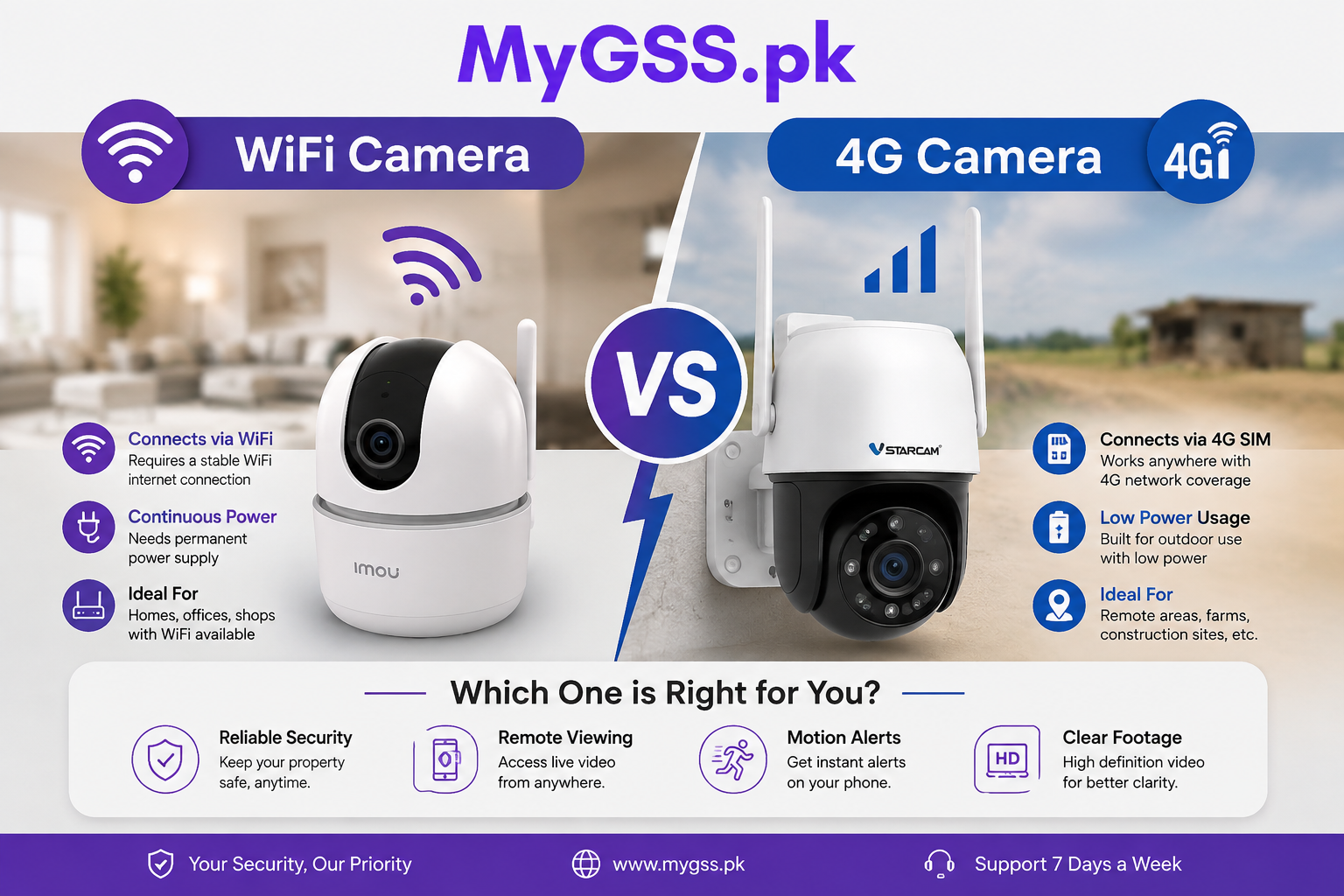
One of the most common questions we get at MyGSS.pk isn’t indoor vs outdoor — it’s WiFi camera vs 4G camera. Both are wireless in the sense that there’s no coaxial cable running to an NVR, but they connect to the internet in completely different ways, and that difference matters a lot depending on where you’re installing the camera and how reliable your electricity and internet actually are.
This guide breaks down exactly how a WiFi camera and a 4G camera differ, what each one costs in Pakistan right now, and which one makes sense for your home, shop, farm, or under-construction plot.
| Feature | WiFi Camera | 4G Camera |
|---|---|---|
| Internet connection | Home/office WiFi router | 4G SIM card (Jazz, Zong, Telenor) |
| Power source | Mains electricity via adapter | Solar panel + battery, or mains |
| Works during loadshedding | No (unless on UPS/inverter) | Yes, runs independently of WAPDA |
| Best for | Homes, shops, offices with stable WiFi | Farms, plots, construction sites, remote areas |
| Setup complexity | Simple — connect to existing WiFi | Simple — insert SIM, position for sunlight |
| Ongoing cost | Uses existing internet plan | Requires an active SIM data plan |
| Typical price in Pakistan | Rs. 2,500 – Rs. 20,000 | Rs. 22,000 – Rs. 45,000 |
A WiFi camera connects to your existing home or office internet router, the same way your phone or laptop does. It needs mains electricity to run (through a plug adapter) and a stable WiFi signal within range. Once connected, you can view live footage, get motion alerts, and play back recordings from anywhere through an app like V380 Pro, IMOU Life, or the VStarcam/O-KAM Pro app.
WiFi cameras are the most common and most affordable wifi camera option in Pakistan, and they’re the right choice whenever:
Popular WiFi camera picks at MyGSS.pk:
A 4G camera skips home WiFi entirely and connects to the internet through a mobile SIM card, the same way your phone gets data when you’re outside WiFi range. Most 4G cameras sold in Pakistan are also solar-powered with a built-in battery, so the camera runs entirely independently of both your WiFi router and your electricity connection.
This makes a 4G camera the clear choice whenever:
Popular 4G camera picks at MyGSS.pk:
This is the single biggest reason people switch from a WiFi camera to a 4G camera in Pakistan. A standard WiFi camera goes offline the moment the power cuts, unless it’s plugged into a UPS or inverter. A solar 4G camera keeps recording and streaming through outages because it isn’t drawing power from the grid at all — it charges from sunlight and stores power in its battery.
Boundary walls, gates, and outbuildings are often just far enough from the router that WiFi signal drops or becomes unreliable. A 4G camera solves this completely since it doesn’t need your router’s signal to reach it — it just needs mobile network coverage, which is available almost everywhere in Pakistan.
Farms, plots, and under-construction sites frequently have neither a WiFi connection nor a stable power supply. This is exactly the gap 4G solar cameras were built for — genuinely usable cctv camera coverage with zero dependency on either.
A WiFi camera rides on your existing internet plan at no extra monthly cost. A 4G camera needs an active SIM with a data plan, which is a small recurring cost on top of the higher upfront price — worth factoring in if you’re comparing total cost of ownership rather than just the sticker price.
Not sure whether you also need an indoor or outdoor housing on top of this decision? Our Indoor vs Outdoor CCTV Camera guide and full 4G solar camera price guide cover that next step in detail.
Can a 4G camera also connect to WiFi? Most 4G solar cameras are built primarily for SIM-based connectivity and are positioned in locations without WiFi, so they’re generally used purely on mobile data rather than switching between the two.
Which Pakistani networks work with 4G cameras? Our 4G camera range works with local SIM cards from Jazz, Zong, and Telenor — any active SIM with a data plan and decent signal coverage at the installation site.
Do I need a separate SIM plan just for the camera? Yes, the 4G camera needs its own active SIM with a data plan running continuously for live viewing and alerts, separate from your personal phone’s SIM.
Is a 4G camera worth it if I already have good WiFi? Usually not — if your WiFi is stable and the installation point is within range, a standard WiFi camera does the same job at a much lower price. 4G cameras earn their higher cost specifically in locations where WiFi and reliable electricity aren’t both available.
Can overseas Pakistanis monitor a 4G camera from abroad? Yes — both WiFi and 4G cameras stream through a smartphone app that works from anywhere with an internet connection, making either option suitable for monitoring family property back home.
There’s no universal “better” camera between WiFi and 4G — it comes down to what’s actually available at your installation site. If you’ve got stable electricity and WiFi, a standard wifi camera will save you money without sacrificing features. If loadshedding, distance from your router, or a total lack of infrastructure is the problem, a 4G solar camera solves it outright. Browse the full range of security camera and cctv cameras price in pakistan options on MyGSS.pk, including every cctv camera for home and off-grid model covered above, all backed by genuine warranty support and a 10-day easy return policy.