Your bag is empty
Don't miss out on great deals! Start shopping or Sign in to view products added.
Shop What's New Sign in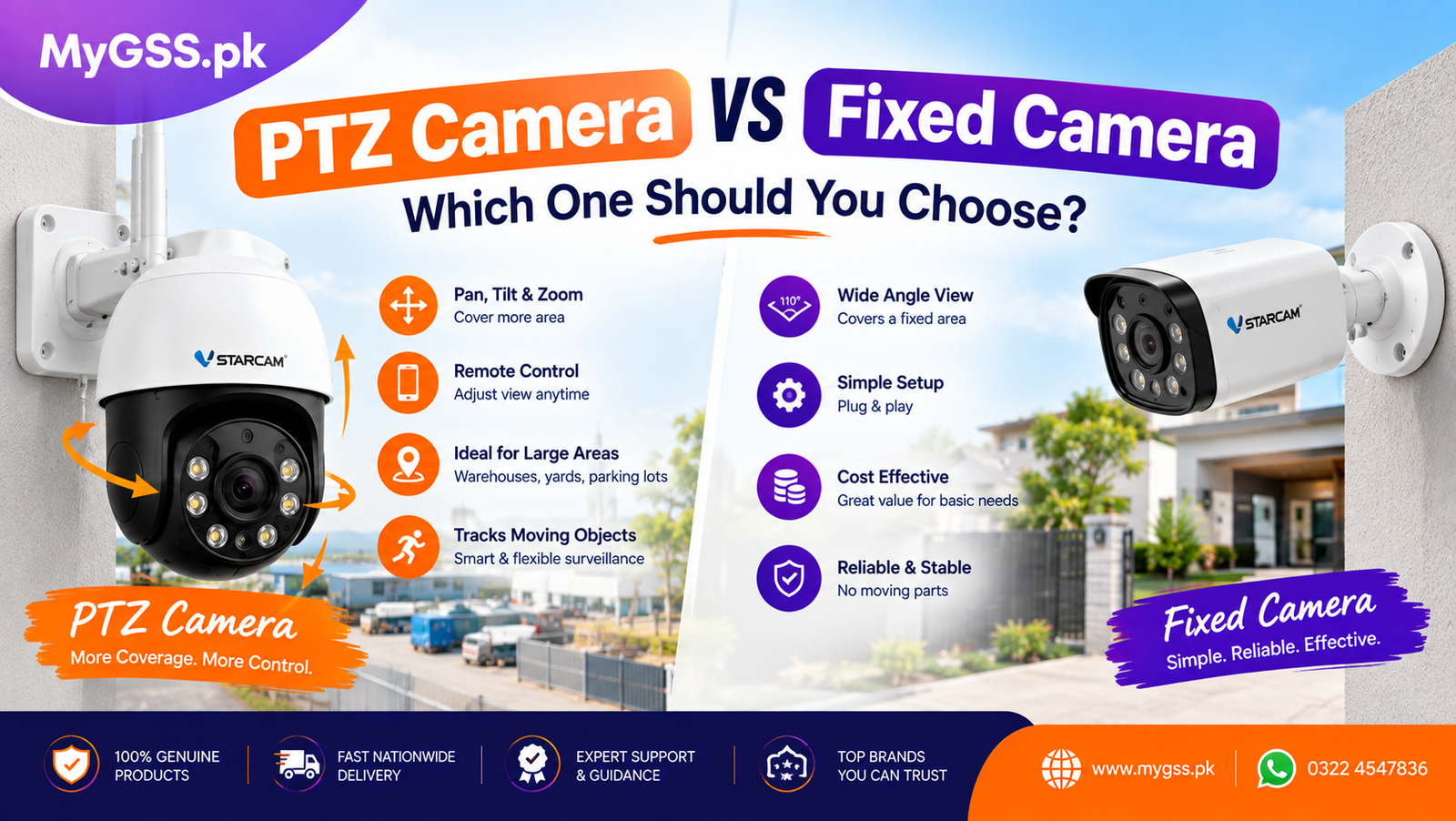
When building a smart security system, one of the most important decisions you’ll face is choosing between PTZ (Pan-Tilt-Zoom) and fixed cameras.
PTZ cameras are motorized devices that can rotate horizontally, tilt vertically, and zoom in on distant subjects. They’re controlled remotely via mobile apps or software, allowing you to actively monitor and track activity in real time .
Fixed cameras stay pointed at a single angle, providing constant, reliable coverage of a specific area. While they can’t move, they offer consistent performance and often come with digital zoom capabilities for basic magnification .
Each has distinct advantages—and the right choice depends on your specific security needs.
A PTZ camera can monitor large spaces that would otherwise require multiple fixed cameras. According to Tapo, a single well-placed PTZ camera can cover driveways, yards, and parking lots, effectively doing the work of several fixed units .
Modern PTZ cameras often include auto-tracking features, automatically following moving people or vehicles. This is particularly valuable for monitoring driveways, side yards, and access roads where activity is dynamic . You can also manually control the camera from your phone to investigate alerts immediately .
Unlike digital zoom (which degrades image quality), optical zoom uses physical lens movement to magnify distant subjects without losing resolution. Many PTZ models offer 20x to 40x optical zoom, capable of capturing license plates or facial details from significant distances .
Fixed cameras never miss what happens in their field of view because they never move. This makes them ideal for entry points, hallways, and critical zones where you need constant monitoring. As FortSense notes, fixed cameras deliver footage “in under two seconds without the mechanical delays inherent in PTZ slewing” .
Without motors and moving parts, fixed cameras have fewer components that can wear out over time. PTZ cameras introduce “single points of failure” through their pan-tilt gears and zoom mechanisms, which can fail under frequent use or harsh weather conditions .
When an alarm triggers, fixed cameras provide immediate, pre-framed footage of the exact zone. PTZ cameras require manual panning or preset navigation, which can delay verification during critical moments .
| Feature | PTZ Camera | Fixed Camera |
|---|---|---|
| Coverage Area | Wide (up to 360°) | Single field of view |
| Movement | Motorized pan, tilt, zoom | None |
| Zoom Type | Optical + digital | Digital (some with optical) |
| Best For | Large open spaces | Entry points, hallways |
| Reliability | More mechanical parts | Fewer failure points |
| Alarm Verification | Slower (requires navigation) | Instant (pre-framed) |
| Cost | Higher | Lower |
| Blind Spot Risk | When camera moves away | None within its view |
Smart wireless cameras rely on Wi-Fi or 4G for connectivity, which introduces unique considerations for PTZ models.
PTZ cameras are bandwidth-hungry. Live video streaming combined with movement commands requires a strong, stable Wi-Fi signal. If your network is weak, the app may lag, motion tracking may stutter, or the feed may drop during peak use .
Power consumption matters. PTZ cameras often require more power than fixed models, especially when they include heaters, motors, or continuous auto-tracking. Battery-powered PTZ cameras may have shorter battery life compared to fixed alternatives .
For Wi-Fi PTZ cameras, consider a wired PoE setup if possible—it provides stable power and connectivity, eliminating battery and signal concerns .
The most effective security systems combine PTZ and fixed cameras rather than choosing one over the other.
Use PTZ cameras for:
Use fixed cameras for:
As IP Cam Talk forum members note, “PTZs with motion tracking are a compliment to an existing fixed camera system and not replacements for fixed cameras” . A PTZ can miss activity when it’s tracking something else or looking in the wrong direction. Fixed cameras ensure you never have a blind spot at critical moments.
OxBlue summarizes it well: “By combining static infrared cameras for continuous, fixed-position monitoring and PTZ cameras for dynamic, flexible coverage, teams can maximize security, improve visibility, and streamline project management” .
A single PTZ can often replace two to four fixed cameras but has limitations. It cannot capture simultaneous events at different locations, and when it’s tracking one subject, it may miss activity elsewhere .
For homes with large properties, multiple entry points, or open outdoor spaces, PTZ cameras offer excellent value by reducing the number of devices needed. However, for smaller homes or apartments, fixed cameras often provide better coverage at a lower total cost .
Yes, but with caveats. Wi-Fi PTZ cameras offer installation flexibility but may experience latency and bandwidth limitations. For best performance, ensure strong Wi-Fi coverage in the camera’s location, or consider a wired PoE setup for critical installations .
Both types offer infrared night vision. Fixed cameras maintain steady WDR performance across their entire view, while PTZ zooming can amplify noise in low-light conditions. However, modern PTZ cameras with starlight sensors and adaptive IR perform well at night .
Choosing between PTZ and fixed cameras isn’t about picking a winner—it’s about matching the right tool to the right job.
PTZ cameras shine in large, open areas where active monitoring and flexibility matter. Fixed cameras excel at reliable, uninterrupted coverage of critical zones. Together, they form a comprehensive security system that covers both the big picture and the critical details.
For most smart wireless camera setups on platforms like mygss.pk, the optimal approach is a layered deployment: PTZ cameras for broad situational awareness and fixed cameras for dependable evidence capture at entry points and high-priority areas.