
Your bag is empty
Don't miss out on great deals! Start shopping or Sign in to view products added.
Shop What's New Sign in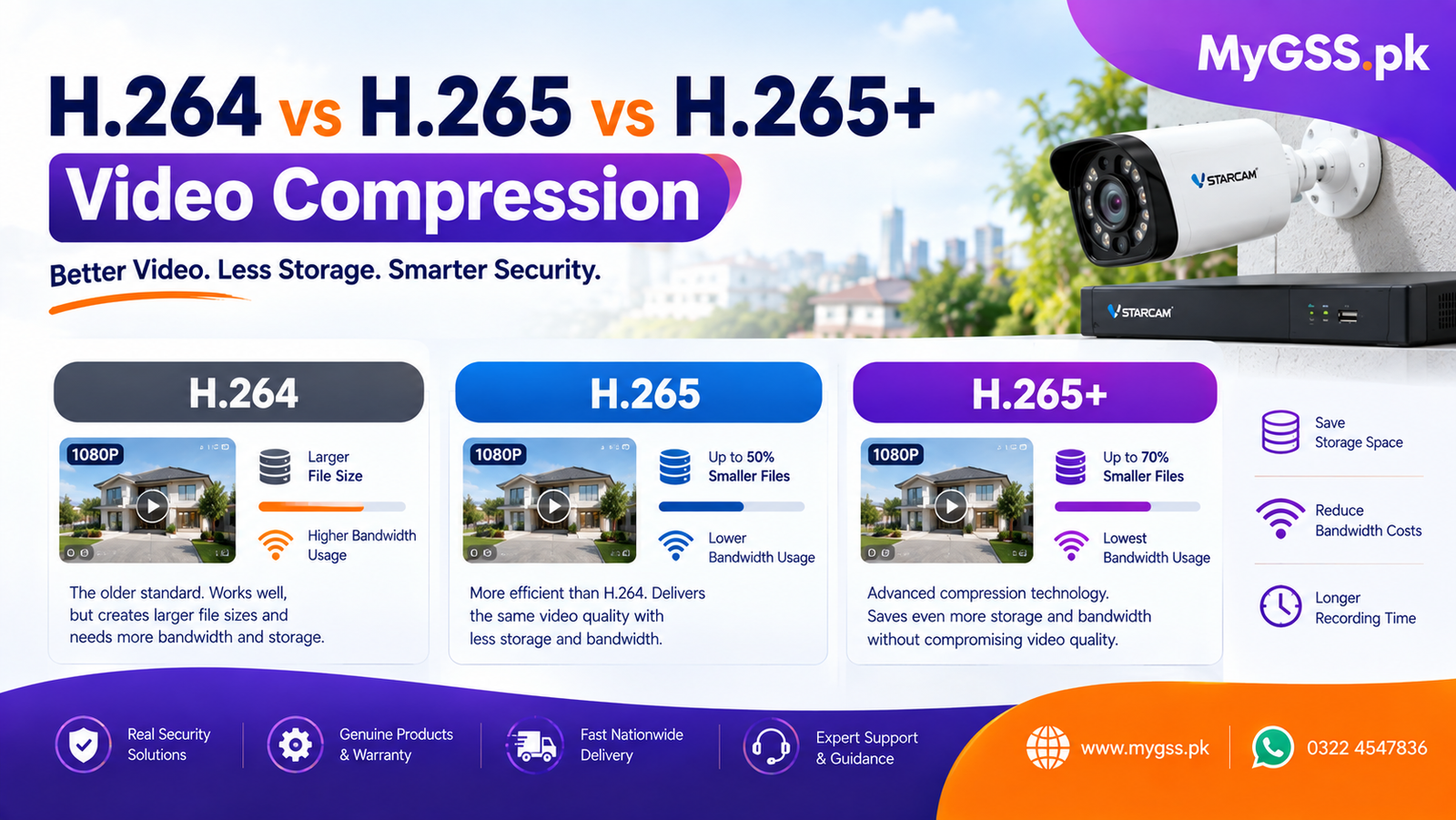
When investing in a smart CCTV camera system for your home or business in Pakistan, most buyers focus on resolution, night vision, or brand name. But there is one technical specification that silently determines how many days of footage you can store, how smoothly your cameras stream over your network, and how much you ultimately spend on hard drives and bandwidth: the video compression codec.
The codec is the engine that compresses raw video data into a manageable file. Choosing the right one—whether it’s H.264, H.265, or H.265+—can mean the difference between two weeks of recorded footage and two months on the same hard drive. This comprehensive guide breaks down the differences between these three compression standards, explains their real-world impact on Pakistani surveillance setups, and helps you make an informed decision when shopping for CCTV cameras at MyGSS.pk, Pakistan’s trusted source for smart security solutions.
Video compression is the process of reducing the file size of video data by encoding only the differences between frames rather than storing every frame in full. In surveillance systems, this is critical because cameras record continuously for 24 hours a day, 7 days a week. Without efficient compression, even a single 1080p camera would generate an overwhelming amount of data that would quickly exhaust any storage system.
The codec you choose directly impacts three critical factors:
For Pakistani buyers, where reliable power and internet infrastructure can vary, choosing an efficient codec is not just about cost savings—it is about building a resilient surveillance system that works consistently.
H.264, also known as AVC (Advanced Video Coding), is an international video encoding standard approved by ITU-T in 2003. For nearly two decades, it has been the dominant codec in video surveillance, streaming, and broadcast media. Its greatest strength lies in its universal compatibility—virtually every camera, recorder, VMS (Video Management System), and media player supports H.264.
H.264 encodes video using fixed macroblocks of up to 16×16 pixels. This predictable grid structure simplifies prediction and decoding, making H.264 less processor-intensive than newer codecs. However, this simplicity also limits how much the codec can compress a video stream without visible quality loss.
For a 1080p camera running at standard frame rates, H.264 typically requires around 4 Mbps of bandwidth and generates approximately 20-30 GB of storage per day per camera. For a 4K camera, that figure jumps to nearly 32 Mbps. In a multi-camera setup, these numbers add up quickly—a 4-camera system can easily require 80-120 GB of storage per day.
H.264 remains a valid choice if:
However, for any new installation in 2026, H.264 should be considered a baseline rather than an optimal choice.
H.265, also known as HEVC (High Efficiency Video Coding), is the successor to H.264, approved by ITU-T in 2013. It was designed specifically to handle the demands of higher-resolution video, including 4K and 8K, where H.264 struggles to balance quality with manageable file sizes.
The key innovation in H.265 is its use of variable Coding Tree Units (CTUs) ranging from 4×4 to 64×64 pixels. Instead of analyzing every part of the image in small, fixed blocks, H.265 can model large uniform areas—like a plain wall or a static background—with very few bits, while allocating more data to complex or moving regions. This adaptive approach boosts compression efficiency significantly while preserving image detail.
H.265 reduces network bandwidth consumption by nearly 50% compared to H.264 at the same level of video quality. In practical terms:
| Resolution | H.264 Bandwidth | H.265 Bandwidth | H.264 Daily Storage | H.265 Daily Storage |
|---|---|---|---|---|
| 720p | 5 Mbps | 2 Mbps | ~50 GB | ~20 GB |
| 1080p | 8 Mbps | 4 Mbps | ~80 GB | ~40 GB |
| 1440p | 16 Mbps | 8 Mbps | ~160 GB | ~80 GB |
| 4K | 32 Mbps | 15 Mbps | ~320 GB | ~150 GB |
Note: Actual results may vary based on scene complexity, frame rate, and camera settings.
For a typical 4-camera 1080p setup, switching from H.264 to H.265 can extend recording retention from approximately 12 days to 24 days on the same 1TB hard drive. For a single 4K camera, the savings are even more dramatic—storage requirements can drop from roughly 28 TB per year to 18 TB.
The efficiency of H.265 comes at a cost. Decoding H.265 streams demands significantly more CPU cycles than H.264, which can cause stuttering on older PCs and some budget NVRs. When planning an H.265 deployment, ensure your recorder and viewing devices are equipped to handle the increased processing load.
H.265 is the optimal balance for most modern surveillance installations:
H.265+ is not a separate international standard. It is a proprietary “smart codec” developed by manufacturers like Dahua and Hikvision, built on top of the standard H.265/HEVC foundation. It represents the most advanced compression technology available for surveillance cameras today.
H.265+ employs a suite of intelligent algorithms that analyze the video scene in real time and apply aggressive compression where it will not affect the important parts of the image. Dahua’s Smart H.265+ reduces bitrate through four key innovations:
The impact of H.265+ is substantial:
In practical terms, this means a 4-camera 1080p system that would store 12 days of footage on H.264 could potentially store 60 to 120 days on H.265+ under the same conditions.
H.265+ is not without its caveats:
H.265+ delivers the greatest value in scenarios where:
| Feature | H.264 (AVC) | H.265 (HEVC) | H.265+ (Smart Codec) |
|---|---|---|---|
| Standard | International (ITU-T, 2003) | International (ITU-T, 2013) | Proprietary (Dahua, Hikvision) |
| Compression Efficiency | Baseline | ~50% better than H.264 | ~67-80% better than H.264 |
| 1080p Bandwidth | ~8 Mbps | ~4 Mbps | ~1.5-2.5 Mbps |
| 4K Bandwidth | ~32 Mbps | ~15 Mbps | ~6-10 Mbps |
| Compatibility | Universal | Broad (most modern devices) | Same-brand camera + recorder |
| Processing Power | Low | Moderate | High |
| Best For | Legacy systems, budget builds | Modern systems, 4K cameras | Maximum retention, static scenes |
| Storage Savings vs H.264 | — | ~50% | ~67-80% |
If you are installing a 2-4 camera system for your home, H.265 is the sweet spot. It offers excellent compression without the vendor lock-in of H.265+, and almost all modern cameras and XVRs from brands like Dahua support it natively. The Dahua 8-Channel 2MP Full-HD CCTV Kit available at MyGSS.pk features H.265+ compression, giving you the best of both worlds—smart codec efficiency with full Dahua ecosystem support.
Businesses recording 24/7—shops, warehouses, factories, and offices—will benefit most from H.265+. The ability to store months of footage instead of weeks on the same hardware translates directly into operational savings. The Dahua kit mentioned above is equally suitable for commercial use, with 8 cameras covering multiple areas and H.265+ ensuring you are not constantly upgrading storage.
If you are deploying 4K cameras, H.265 is the minimum requirement. H.264 would generate unmanageable file sizes (over 300 GB per camera per day), while H.265 brings this down to a manageable ~150 GB. H.265+ can push it even lower, but ensure your recorder supports the resolution and codec combination.
If you are working with an existing H.264 DVR and simply adding cameras, stick with H.264 for compatibility. However, if you are building a new system on a tight budget, the Tenda CT6 V1.0 Outdoor Wi-Fi 3MP 2K Camera at MyGSS.pk offers H.265 compression at an accessible price point, delivering efficient storage without compromising on 2K resolution.
Regardless of which codec you choose, these configuration tips will help you get the most out of your surveillance system:
Q: Will H.265+ work with my existing H.264 DVR?
A: No. H.265+ requires both the camera and the recorder to support the codec. You will need an H.265+ compatible XVR or NVR.
Q: Is H.265+ worth the extra cost?
A: If you record continuously and want to maximise retention without buying larger hard drives, yes. The savings on storage hardware and the convenience of longer retention often outweigh the slight premium.
Q: Can I mix H.264 and H.265 cameras on the same recorder?
A: Yes, most modern XVRs and NVRs support multiple codecs simultaneously. However, the recorder’s storage and bandwidth will be determined by the least efficient stream.
Q: Does H.265+ affect video quality?
A: When properly configured, H.265+ maintains high-quality video for moving objects and areas of interest. The aggressive compression is applied primarily to static backgrounds, which is acceptable for most surveillance scenarios.
Q: Which brands offer H.265+ in Pakistan?
A: Dahua and Hikvision are the leading manufacturers offering H.265+ technology. Both brands are available at MyGSS.pk, Pakistan’s trusted online store for smart CCTV cameras.
The choice between H.264, H.265, and H.265+ is ultimately a trade-off between compatibility, efficiency, and cost. For any new installation in 2026, H.265 should be your baseline, with H.265+ delivering the best long-term value for continuous recording scenarios. For Pakistani buyers seeking reliable, genuine surveillance equipment with expert guidance, MyGSS.pk offers a curated selection of Dahua, Hikvision, and Tenda cameras and kits—all backed by local warranty and support.
Want to see exactly how many days your own camera setup will store? Use our CCTV hard drive size estimator to calculate storage based on camera count, resolution, codec, frame rate, and retention target.
Ready to upgrade your security system? Browse the complete range of H.265 and H.265+ smart CCTV cameras at MyGSS.pk — Pakistan’s trusted destination for smart security solutions.