Your bag is empty
Don't miss out on great deals! Start shopping or Sign in to view products added.
Shop What's New Sign in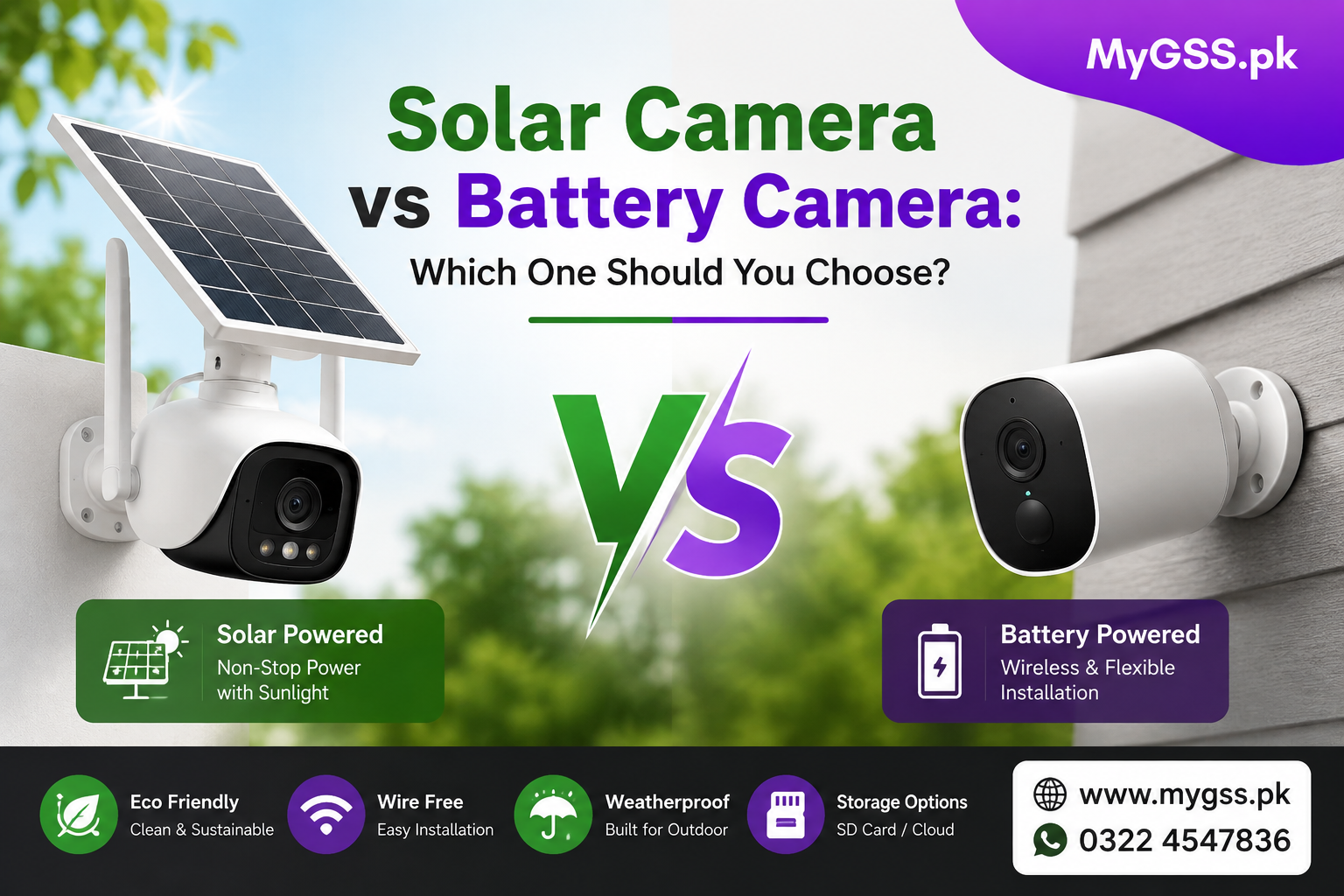
Choosing a wireless security camera used to mean one simple question: indoor or outdoor?
Nevertheless, Solar Camera vs Battery Camera is a key distinction to consider for placement and maintenance.
Both options free you from running cables through walls. Both let you place a camera almost anywhere on your property.
But the way they get their power is different. That difference affects installation location and how often you think about your camera.
If you’re comparing options for your home, shop, farmhouse, or warehouse, this guide breaks down Solar Camera vs Battery Camera. It explains how they stack up, so you can pick the right one the first time.
A solar camera is a battery-powered camera paired with a small solar panel. The panel continuously trickle-charges the internal battery during daylight hours, so in ideal conditions the camera never needs to be taken down or plugged in.
Best suited for: gates, boundary walls, rooftops, driveways, farmhouses, and any spot with direct or partial sunlight for most of the day.
A battery camera runs entirely on its internal rechargeable battery, with no solar panel involved. Depending on usage and battery size, it typically lasts anywhere from 30 to 180 days before needing a recharge. You simply remove the battery (or the whole unit), charge it via USB, then reinstall it.
Best suited for: porches, hallways, shaded corners, indoor-outdoor entryways, and rental properties where drilling or wiring isn’t ideal.
Solar Camera vs Battery Camera: Side-by-Side Comparison
| Feature | Solar Camera | Battery Camera |
|---|---|---|
| Power source | Solar panel + built-in battery | Rechargeable battery only |
| Maintenance | Minimal — self-charging in sunlight | Periodic recharging required (weeks to months) |
| Best installation spot | Direct/partial sunlight areas | Shaded or indoor-adjacent areas |
| Upfront cost | Slightly higher (includes panel) | Lower |
| Long-term convenience | Very high once installed correctly | Moderate — needs manual recharge cycles |
| Winter/cloudy performance | Reduced charging, battery buffer helps | Unaffected by weather |
| Installation flexibility | Needs sunlight exposure | Can go almost anywhere |
| Ideal for | Outdoor perimeters, gates, rooftops | Porches, shaded entries, indoor-outdoor spots |
This is the core trade-off. A solar camera in a well-lit spot can run indefinitely without any human intervention. The panel keeps the battery topped up every day the sun is out. But place it somewhere shaded, under a roof overhang, or facing north, and it may barely charge at all, leaving you no better off than a plain battery camera.
A battery camera has a fixed, predictable runtime. There is no guesswork about sun exposure; you know roughly when it will need a charge, and you can plan around it. For low-traffic areas that do not trigger many recordings, that charge cycle can stretch to months.
Solar cameras need a spot with genuine sun exposure for several hours a day. Ideally, it should face a direction with no obstruction from trees, walls, or roof overhangs. This makes them the natural choice for outdoor perimeter security: main gates, boundary walls, rooftops, and driveways.
Battery cameras have no such restriction. You can mount one under a covered porch, inside a stairwell, or on a shaded balcony — anywhere a wired camera couldn’t easily go, without worrying about sunlight at all.
Solar cameras usually cost more upfront because you are paying for the panel and mounting hardware along with the camera itself. Over time, that cost can pay for itself in convenience. There is no electricity impact, and you have far fewer trips up a ladder to swap batteries.
Battery cameras are generally cheaper to buy but carry a small ongoing cost in time and effort: charging and monitoring battery levels through the app, and occasionally buying spare battery packs if you want zero downtime.
For most of Pakistan, solar cameras are a strong fit for a large part of the year thanks to long, sunny days. This is especially true from March through October. During shorter winter days or overcast weather, charging slows down. A solar camera installed in partial shade may need occasional manual top-ups in winter. In dusty environments, wiping the panel clean periodically keeps charging efficient.
Battery cameras aren’t affected by weather at all, making them a dependable choice for shaded areas where a solar panel wouldn’t get enough light regardless of season.
Ask yourself these three questions.
Many homes and businesses end up using both: solar cameras on the gate, boundary wall, and rooftop where the sun does the work, and battery cameras on porches, shaded entries, or garages where sunlight isn’t reliable.
There is no single winner between solar and battery cameras. The right choice depends entirely on where the camera will live. Solar cameras reward sunny, exposed locations with near-zero maintenance. Battery cameras offer flexibility for shaded or indoor-adjacent spots where solar isn’t practical.
At MyGSS, we help homes and businesses across Pakistan choose and install the right mix of wireless security cameras — solar, battery, and wired — based on your property’s layout and lighting. Get in touch with our team to find the setup that fits your space.
Do solar cameras work on cloudy or rainy days? Yes, but charging slows down. The internal battery provides a buffer, so a few cloudy days generally won’t cause downtime as long as the camera gets some sun during clearer periods.
Can I add a solar panel to a battery camera later?
Many battery camera models support an optional solar panel accessory. Check your specific camera’s compatibility before purchasing.
Which lasts longer without maintenance — solar or battery? A well-placed solar camera lasts indefinitely without maintenance. A battery camera requires recharging every one to six months depending on usage and battery size.
Is a solar or battery camera better for a shop entrance in Pakistan? Direct sunlight makes solar ideal for entrances exposed most of the day. If the entrance is shaded by an awning or indoors-adjacent, a battery camera is more reliable.