Your bag is empty
Don't miss out on great deals! Start shopping or Sign in to view products added.
Shop What's New Sign in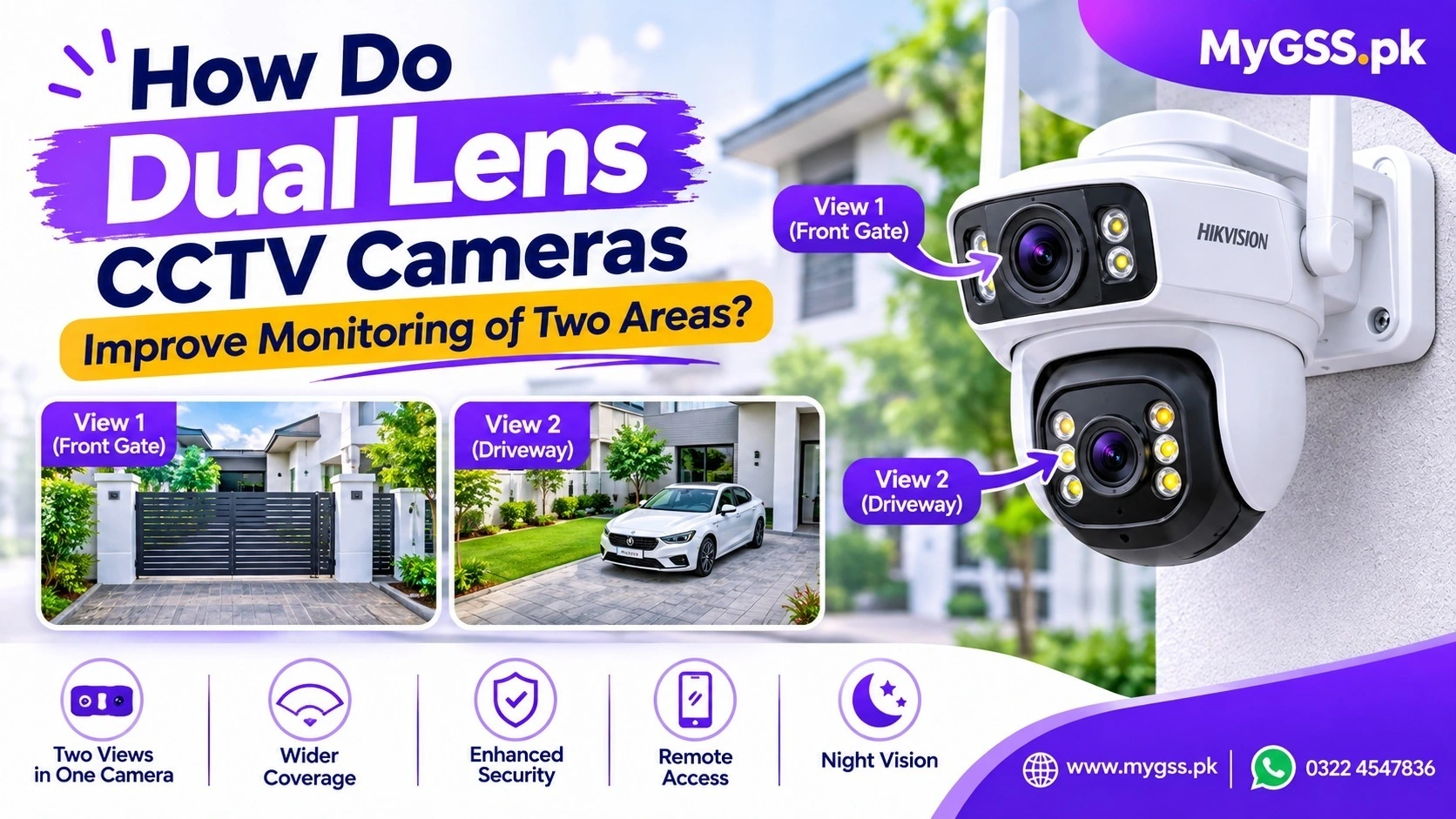
Monitoring multiple areas of a property is an important part of modern security. Whether you want to protect your home, business, warehouse, farmhouse or parking area, having clear visibility of different locations can help you identify suspicious activity and improve overall security.
Traditional CCTV cameras usually provide a single viewing perspective. This means that monitoring two different areas may require installing two separate cameras. However, modern dual lens CCTV cameras offer another solution by combining two camera lenses into one device.
With two viewing perspectives, these cameras can help monitor separate locations, expand surveillance coverage and reduce the need for multiple camera units in suitable installations.
But how exactly do dual lens CCTV cameras work, and why are they becoming a popular choice for residential and commercial security?
Let’s explore their advantages and practical applications.
A dual lens CCTV camera is a surveillance device equipped with two separate optical lenses within a single camera housing. Each lens captures its own viewing perspective, allowing the camera to monitor two directions or areas.
Depending on the model, both lenses may offer different functions.
For example, some dual lens cameras feature:
Some advanced models also support simultaneous viewing of both camera feeds through a compatible smartphone application.
This makes a dual lens security camera particularly useful when two monitoring locations are close enough to be covered from a single mounting position.
The main advantage of a dual lens camera is that it provides two separate viewing perspectives from one device.
Imagine installing a security camera outside your house.
You want to monitor both the main entrance and the driveway. With a conventional single-lens camera, you may need to choose one location or compromise on the viewing angle.
A dual lens CCTV camera can provide a different approach.
One lens can monitor the main entrance while the second lens covers the driveway. Depending on the camera configuration, both views can be accessed through the supported mobile application.
This allows property owners to monitor two important locations without necessarily installing two independent camera units.
One of the biggest advantages of dual lens CCTV cameras is their ability to provide two separate viewing perspectives.
Instead of relying on a single viewing angle, users can monitor different locations through the same camera device.
Common examples include:
On supported models, both camera feeds can be displayed simultaneously, helping users keep an eye on multiple locations.
A single CCTV camera may not provide sufficient coverage when monitoring large or irregularly shaped spaces.
Dual lens cameras offer additional viewing flexibility by combining two lenses with different viewing directions or angles.
This can be particularly useful for:
The actual coverage depends on lens specifications, camera positioning and the distance between monitoring locations.
Installing separate CCTV cameras for nearby monitoring points can increase equipment requirements.
A dual lens camera can combine two viewing units into one housing, potentially reducing the number of devices required for a particular installation.
Some practical advantages include:
However, a dual lens camera cannot replace two independently positioned cameras in every situation. Locations that are far apart may still require separate devices.
Some advanced dual lens security cameras combine a fixed camera lens with a PTZ (Pan, Tilt and Zoom) lens.
This combination provides two different surveillance functions.
The fixed lens continuously monitors a selected area, while the motorized PTZ lens can rotate horizontally and vertically to inspect other locations.
For example, the fixed lens can monitor your front gate while the PTZ lens moves towards the driveway or garden.
This combination provides more monitoring flexibility than a conventional fixed-view camera.
Outdoor security often requires monitoring more than one location.
A dual lens outdoor CCTV camera can be useful for monitoring:
For outdoor installations, look for weather-resistant housing, suitable night vision and reliable connectivity.
For locations without WiFi coverage, a compatible 4G dual lens security camera can connect through a SIM card and provide remote monitoring through a supported mobile application.
Modern dual lens cameras often support mobile applications that allow users to monitor their property remotely.
Depending on the camera and its application, users may be able to:
This makes it easier to monitor important locations while travelling, working or staying away from home.
For properties that need two nearby monitoring perspectives, a dual lens camera can offer good value.
Instead of purchasing two separate camera devices, users may be able to cover both locations with a single dual lens unit.
This can potentially reduce equipment costs, mounting requirements and installation complexity.
The overall savings depend on the camera model, required recording capacity, installation location and surveillance requirements.
Dual lens security cameras are suitable for several residential and commercial applications.
Homeowners can use dual lens cameras to monitor their main entrance, driveway, garden and other outdoor areas.
A camera installed near the entrance can provide two different viewing perspectives to help improve property monitoring.
Shop owners can monitor customer entrances and another important area, such as the surrounding counter or parking space, depending on the camera configuration.
Farmhouses often have large outdoor spaces that require surveillance.
A dual lens camera with 4G connectivity can be useful where conventional internet connections are unavailable.
Businesses can use dual lens CCTV cameras to monitor entrances, reception areas, corridors and nearby outdoor spaces.
Dual lens cameras can provide additional viewing flexibility when monitoring vehicle entrances, loading areas and surrounding spaces.
What makes a dual lens camera different from a traditional CCTV camera?
| Feature | Single Lens Camera | Dual Lens Camera |
|---|---|---|
| Number of lenses | One | Two |
| Viewing perspectives | One primary view | Two views |
| Monitoring flexibility | Limited to one lens | Two viewing perspectives |
| PTZ functionality | Available on selected models | Available on selected models |
| Mobile monitoring | Model dependent | Model dependent |
| Best application | Single monitoring location | Two nearby monitoring locations |
A single lens camera is a good choice when you only need to monitor one specific location. However, a dual lens camera may be more suitable when you want to monitor two different areas from one installation point.
Not every dual lens CCTV camera offers the same specifications. Before purchasing, consider the following factors.
Camera Resolution: Check the resolution of each lens separately. Do not assume that the advertised combined megapixel figure represents the resolution of each individual lens.
Independent Lens Movement: Check whether the lenses are fixed, independently adjustable or motorized.
Simultaneous Dual View: Confirm whether the camera supports displaying both views at the same time.
Night Vision: Look for infrared night vision or colour night vision features according to your requirements.
Connectivity: Choose WiFi or 4G connectivity based on internet availability at your property.
Storage: Check microSD card capacity and any supported cloud recording options.
Mobile Application: Make sure the camera supports a compatible application for live monitoring, playback and notifications.
Weather Resistance: For outdoor use, check the IP rating and suitability for different weather conditions.
The answer depends on your monitoring requirements.
If you need to monitor two nearby areas from one suitable mounting position, a dual lens camera can be a practical alternative to installing two separate camera units.
However, if the locations are far apart, require different mounting heights or need completely independent surveillance coverage, two separate cameras may be a better option.
The important thing is to choose a camera based on the actual layout of your property rather than focusing only on the number of lenses.