Your bag is empty
Don't miss out on great deals! Start shopping or Sign in to view products added.
Shop What's New Sign in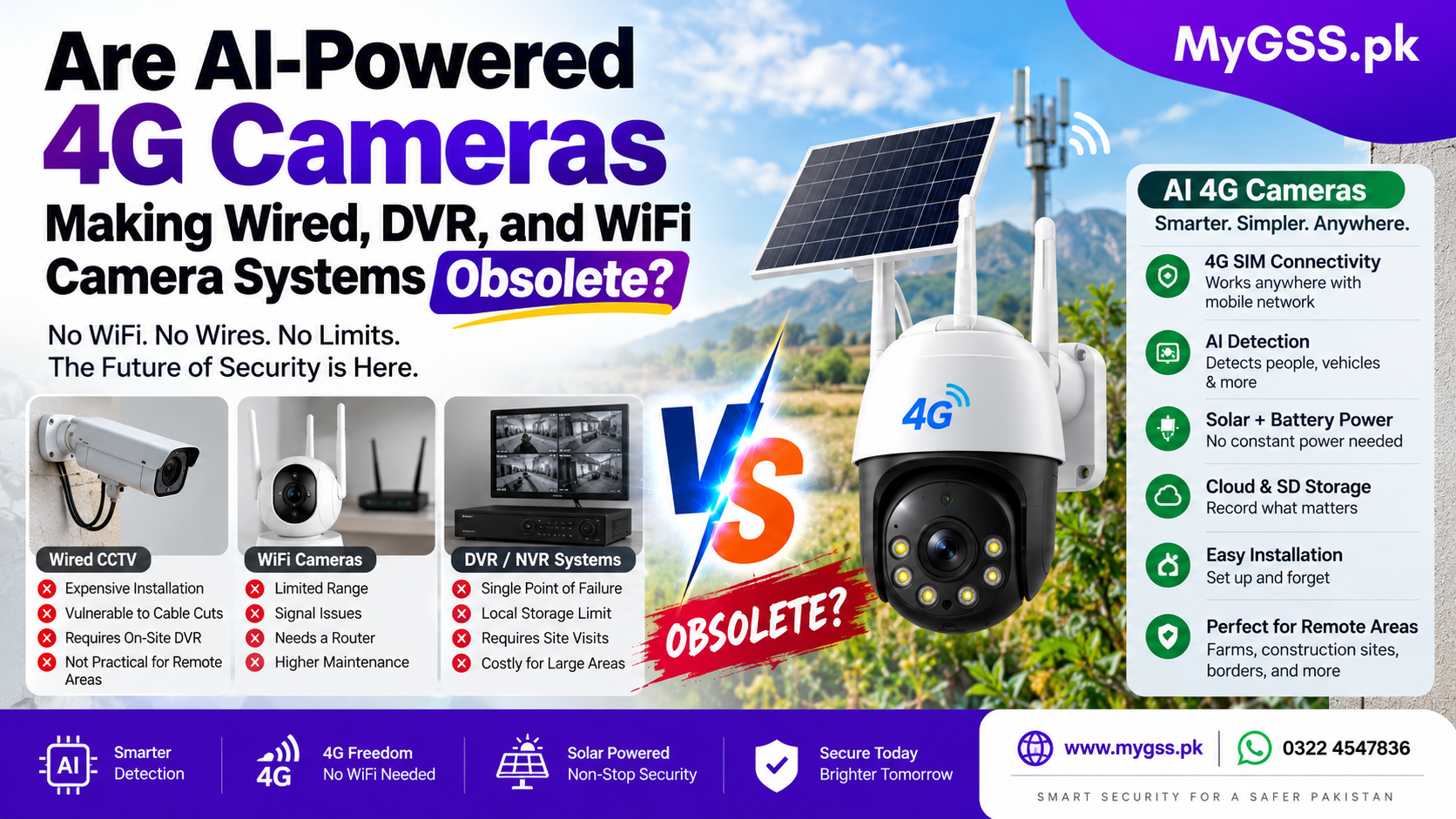
For two decades, “security camera” meant one of three things: a wired CCTV system tied to a DVR down the hall, a WiFi camera tied to a router down the same hall, or a hybrid setup using local storage on-site. All three share the same hidden assumption — that the camera will always be close enough to fixed infrastructure, whether that’s a cable run, a router signal, or a physical box to hold the recording. That assumption breaks the moment you try to secure a farm boundary two kilometers from the nearest building, a highway checkpoint, a pipeline running through open desert, or a construction site that has no permanent power at all.
4G SIM-based cameras were the first real answer to that gap. But on their own, they only solved connectivity. It’s the combination of AI video analysis, minimal cloud storage models, and solar-plus-battery power that’s turning them into something bigger: a security model that doesn’t need WiFi, doesn’t need constant power, and barely needs anyone to think about it once it’s installed. That combination is worth examining closely, because it changes not just how homeowners think about cameras, but how governments and large infrastructure operators might approach security at scale.
WiFi cameras have a hard ceiling. Past 50–100 meters from a router, signal degrades fast, and extending it means mesh systems, repeaters, or running cable — all of which cost money and require someone to maintain them. For a single house, that’s an inconvenience. For securing a stretch of farmland, a warehouse perimeter, or a remote utility site, it’s often simply not viable. Wired systems solve the range problem but introduce a bigger one: trenching cable across a large property or a rural site is expensive, slow, and vulnerable to the exact kind of tampering or theft a security system is supposed to prevent.
This is where the cost math traditionally broke down. Businesses and government bodies securing large or remote areas faced a choice between paying for expensive fixed infrastructure or leaving gaps in coverage. 4G connectivity removes the range constraint almost entirely — a camera anywhere with cellular coverage can transmit, with no router, no cable trench, and no line-of-sight requirement. The practical effect is that “can we put a camera there” stops being an infrastructure question and becomes a coverage-map question.
Traditional wired CCTV — whether it’s analog cameras tied to a DVR, or IP cameras tied to an NVR — looks more robust on paper — dedicated cabling, a physical recorder on-site, no reliance on a home router. In practice, it carries its own set of fixed-infrastructure liabilities that make it just as impractical for large or remote deployments:
Cable runs are expensive and vulnerable. Every camera needs a physical line back to the recorder — coaxial for a DVR setup, or Ethernet/PoE for an IP camera feeding an NVR. Either way, that’s trenching or conduit work for anything beyond a single building, and that cable is an obvious target: cut it, and every camera on that run goes dark simultaneously.
The DVR or NVR is a single point of failure. All recordings live in one physical box, on-site. Damage it or steal it during a break-in, and the footage is gone, exactly when it was needed most. IP camera systems reduce cable count somewhat with PoE, but the NVR itself is just as centralized and just as vulnerable as a DVR is.
Local storage has a hard ceiling. DVR and NVR hard drives fill up and overwrite older footage on a loop, usually within days or a couple of weeks depending on channel count and resolution. There’s no meaningful long-term archive without continuously swapping or expanding physical drives.
Maintenance requires a site visit. A firmware update, drive failure, network switch issue, or configuration change on a wired DVR/NVR system typically means someone has to physically be there — not practical for a remote pipeline segment or a rotating construction site.
In other words, wired-and-recorder systems — DVR or NVR, analog or IP — solve WiFi’s range problem by trading it for a different fixed-infrastructure problem: dependency on cabling and a single on-site recording device, both of which are expensive to install at scale and fragile exactly when security matters most.
Solving connectivity used to just move the problem downstream to storage. A camera that’s always online and always recording generates enormous amounts of footage, most of it useless — empty roads, still warehouses, wind moving through grass. Storing that continuously, whether on a local SD card, an onsite DVR, or a full cloud subscription, gets expensive fast, and for large-scale deployments across dozens or hundreds of cameras, that cost multiplies quickly.
This is where AI integration changes the equation, not by adding a flashy feature, but by attacking the actual cost driver.
Modern AI-based detection can distinguish between a person, a vehicle, an animal, and background motion like wind or shadows. Instead of a camera continuously streaming and storing hours of empty footage, it can:
Stay in a low-power, low-data monitoring state until it detects a relevant event
Record and upload short clips tied to actual activity, rather than 24 hours of continuous video
Tag and timestamp events automatically, so reviewing footage means scanning a list of flagged incidents instead of scrubbing through a full day’s recording
The practical result is a massive drop in both storage volume and data usage. A property that might have generated 50GB of raw footage a day can often be represented by a few hundred megabytes of AI-flagged events covering everything that actually matters. That’s the mechanism behind “low storage” and “minimal cloud storage” claims — it’s not that footage is being compressed harder, it’s that far less footage is being kept in the first place, because most of what a static camera records has zero security value.
There’s an instinct to assume that keeping less raw footage is a downgrade. In an event-based AI model, it’s closer to the opposite. A 30-day archive of continuous footage is expensive to store and slow to search. A 30-day archive of AI-tagged events covering every person, vehicle, or motion incident that occurred is smaller, faster to search, and arguably more useful, because it’s already organized around the moments an investigator or property owner would actually want to see.
This also solves a real vulnerability shared by every local-storage system, whether it’s an SD card in a standalone camera or a full DVR bank in a server room: the recording lives physically at the site being protected, which means it can be stolen, damaged, or destroyed in exactly the incident it was meant to capture. It also means storage capacity is a hard, recurring problem — old footage gets overwritten on a loop, and “keeping more history” means buying and swapping bigger drives indefinitely. Cloud-based event storage removes both issues at once. Even minimal cloud storage — just the flagged clips, not full continuous video — means the evidence that matters survives even if the camera or DVR hardware doesn’t, and there’s no physical drive to fill up or maintain.
Connectivity and storage solve two problems. Power is the third, and it’s often the one that quietly causes the most real-world failures. A camera that loses power goes dark, and in remote locations, that outage can go unnoticed for hours or days.
Pairing 4G cameras with solar panels and battery backup addresses this directly:
Solar charging means the camera doesn’t depend on grid power or an extension cord run across a field
Battery backup carries the system through cloudy days, nighttime, and short-term panel issues without interruption
AI-driven low-power monitoring stretches battery life further, since the camera isn’t burning power on continuous high-bandwidth streaming
The combined effect is close to zero planned downtime. A properly sized solar-battery setup keeps the camera running indefinitely without site visits, generator fuel, or grid dependency — which matters enormously for the kind of remote or temporary sites where security has traditionally been hardest to maintain.
Even after removing wires, routers, and on-site recorders, one physical dependency remained for years: someone still had to open the camera, insert a physical SIM card, and make sure it had an active plan before the device could go online. That’s a small step, but it’s still a step — it means every unit needs a person to touch it before it can work, and swapping carriers or reactivating a lapsed plan means physically returning to the device.
Modern 4G cameras with digital SIM (eSIM) technology remove that last piece of physical contact. The SIM profile is built into the device or provisioned remotely, which means:
No physical card to insert, lose, or damage. The camera ships ready to connect, with no slot to open and no card to source separately.
Activation happens from the app. A camera can be enabled, given a data plan, or switched to a different carrier entirely from the same mobile app used to view footage — no site visit required.
Recharging a plan is a remote action. If a data plan lapses, reactivating it is a few taps in an app, not a trip back to a device that might be on a rooftop, a remote pole, or across a border.
Deployment becomes install-and-forget. A technician can mount the camera, and everything else — network activation, plan management, carrier switching — happens afterward, remotely, by whoever manages the account.
This is a small detail on a spec sheet, but it’s the logical endpoint of everything else in this piece. Wired systems needed a person on-site for cabling and drive maintenance. WiFi systems needed a person on-site to configure the router connection. Even early 4G cameras needed a person on-site at least once, to physically insert a SIM. Digital SIM removes that final requirement. Once a camera is mounted with a clear view of the sky for its solar panel, every remaining step — activation, connectivity management, plan renewal, even carrier changes — can happen without anyone standing next to the device again. That’s the difference between a camera that’s remotely monitored and one that’s genuinely autonomous from the moment it’s installed.
What This Removes From the Equation
Put the three pieces together — 4G connectivity, AI-based event storage, solar/battery power — and add digital SIM activation on top, and what disappears is the list of excuses that used to justify leaving a location unmonitored, or that used to justify accepting the fragility of wired, DVR, and NVR-based systems:
Distance from a router? Irrelevant. The camera only needs cellular coverage.
Cost of cabling or trenching for power, network, or DVR/NVR wiring? Removed. No wired power, wired network, or wired video-signal run is required.
A single DVR or NVR as the only copy of the footage? Removed. Cloud-based event storage means there’s no on-site box that can be stolen or destroyed to erase the record.
Storage cost and capacity limits of continuous local recording? Minimized. AI keeps only what’s relevant, so there’s no drive to fill up, overwrite, or physically swap out.
Power availability? Solved through solar and battery, with AI reducing the load in the first place.
A physical SIM card that needs sourcing, inserting, or swapping? Removed. Digital SIM handles activation, plan renewal, and carrier changes remotely.
Downtime from outages or a site visit to fix hardware? Reduced close to zero, since the system isn’t dependent on any single fragile link — grid power, WiFi, wired video runs, or physical drive maintenance all become unnecessary.
That’s a meaningfully different security model than “install a camera and hope the router reaches it.” It’s closer to deploying a self-contained unit that only needs sky exposure and cellular signal — which is a very different proposition for large-scale or remote security planning.
Why This Matters Beyond Individual Properties
For a homeowner or small business, this shift mostly means fewer installation headaches and lower running costs. For governments and large infrastructure operators, it’s a bigger deal, because it changes what’s economically and logistically feasible to monitor at all.
Consider the kinds of assets that are traditionally hard to secure precisely because of distance and cost: highways and checkpoints stretching across open terrain, pipelines and utility corridors running through unpopulated land, agricultural land and irrigation infrastructure, border and perimeter zones, and construction sites for large public projects that have no permanent power or network infrastructure for the duration of the build. In every one of these cases, the traditional obstacles were never really about whether security cameras were useful — it was about whether deploying and maintaining them was practical.
Self-powered, cellular-connected, AI-filtered cameras change that math. A department overseeing a highway corridor doesn’t need to run fiber or grid power to every checkpoint; it needs cellular coverage and a mounting point. A utility company monitoring a pipeline doesn’t need to justify a full wired security system for every few kilometers; it needs a scattering of self-contained units that report events, not raw footage, back to a central system. Large public infrastructure projects — the kind that used to leave construction sites unmonitored simply because running temporary security infrastructure wasn’t worth it for a project’s build phase — can deploy the same low-maintenance model for the duration of the work and relocate the hardware afterward.
Whether governments and mega-infrastructure operators actually move in this direction depends on more than just technical feasibility. Procurement cycles, data sovereignty requirements, and integration with existing command-and-control systems all move slower than hardware innovation does. But the underlying incentive is strong: the same AI-plus-cellular-plus-solar model that removes cost and distance limitations for a single farm scales in a way that traditional wired or WiFi-dependent systems structurally cannot. It’s easier to imagine large-scale adoption of self-contained, AI-filtered units than it is to imagine trenching cable and building substations to secure every remote stretch of a national infrastructure network.
Where Caution Still Applies
None of this removes the need for basic security hygiene. Cellular-connected, cloud-reporting cameras are still only as trustworthy as their encryption, authentication, and firmware update practices. A device that’s easy to deploy anywhere is also a device that needs to be hardened against interception and tampering, particularly for anything approaching government or critical-infrastructure use. AI event detection reduces storage and bandwidth costs, but it also needs to be reliable enough not to miss the events that actually matter — a system that filters too aggressively just moves the blind-spot problem rather than solving it. And solar-battery power removes grid dependency, but system sizing still has to account for real-world weather variance, not best-case sunlight assumptions.
The Bigger Picture
The shift underway isn’t really about any single feature. WiFi range limits, DVR cabling costs, local storage capacity, and power outages were never separate problems — they were four faces of the same core limitation: security systems that depended on fixed, local infrastructure to function, whether that infrastructure was a router, a length of coaxial or Ethernet cable, or a hard drive sitting in a box on-site. 4G connectivity, AI-based event storage, and solar-battery power each remove one dependency, and together they remove nearly all of them.
That’s why the comparison to WiFi cameras alone understates what’s actually changing. It’s less “4G camera versus WiFi camera” and more a move away from every form of location-dependent security — wired, DVR-based, and WiFi alike — toward self-contained units that can be placed almost anywhere coverage exists and left to run with minimal intervention. For individual properties, that means fewer installation constraints and no on-site box to protect or maintain. For governments and large infrastructure operators facing the much harder problem of securing thousands of kilometers of remote assets, it may be the difference between “monitored” and “unmonitored” at a scale wired and DVR-based systems could never realistically reach.
For a practical look at how this model is being built into consumer and small-business hardware today, MyGSS.pk’s 4G solar-powered security cameras combine SIM-based connectivity with solar and battery backup — a smaller-scale version of the same architecture that’s likely to define how remote and large-scale security gets deployed going forward.