Your bag is empty
Don't miss out on great deals! Start shopping or Sign in to view products added.
Shop What's New Sign in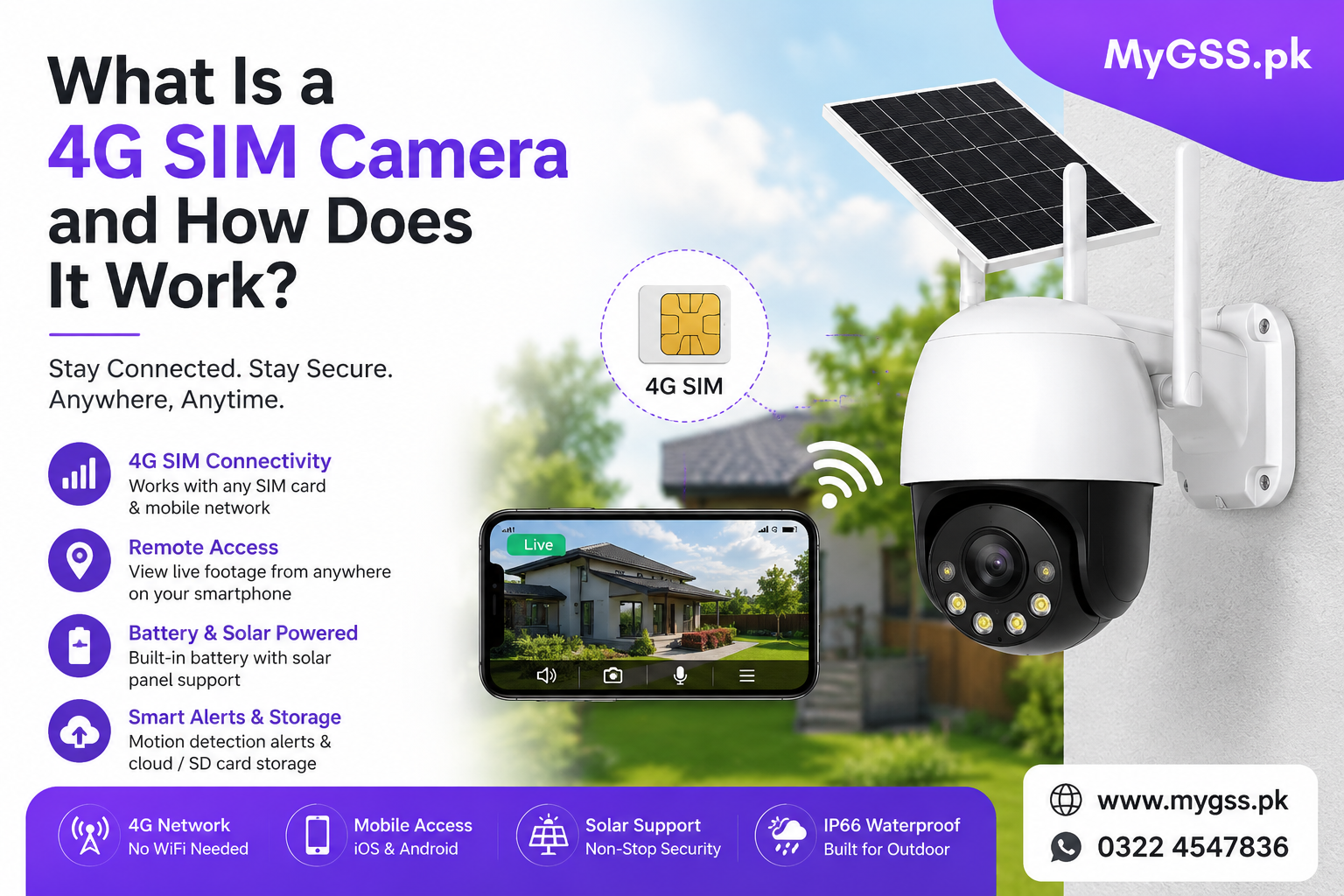
If you’ve been shopping for a security camera lately, you’ve probably come across the term 4G SIM camera and wondered how it’s different from the Wi-Fi cameras most people already know. This guide breaks down exactly what a 4G SIM camera is, how it works, and why it’s becoming a popular choice for homes, farms, job sites, and remote properties without reliable internet.
A 4G SIM camera is a security camera that connects to the internet using a cellular network instead of Wi-Fi or an Ethernet cable. Just like a smartphone, it has a slot for a physical or embedded SIM card that links it to a mobile carrier’s 4G LTE network. This means the camera can send live video, alerts, and recorded footage to your phone from virtually anywhere there’s cellular coverage — no router, no broadband, no local network required.
These cameras are also commonly called 4g Cameras, cellular security cameras, 4G LTE cameras, or SIM card cameras, and they’re built specifically for locations where running Wi-Fi or cables isn’t practical.
Understanding how a 4G SIM camera works is easier when you break it down into a few core steps:
Inside the camera is a SIM card slot, similar to what you’d find in a mobile phone. Once you insert an active data SIM from a supported carrier, the camera registers itself on that carrier’s 4G LTE network, just as your phone does when it powers on.
The camera’s onboard sensor continuously records footage. Most 4G SIM cameras use motion detection, PIR (passive infrared) sensors, or AI-based detection to identify movement, people, vehicles, or animals within their field of view, rather than recording nonstop.
When motion is detected — or on a scheduled interval — the camera compresses the video and sends it over the 4G network to the cloud or directly to your smartphone app. This uses mobile data, similar to streaming a video call on your phone.
Through a companion mobile app, you get push notifications the moment something happens. You can then view live video, review recorded clips, and in many models, use two-way audio to speak through the camera in real time.
Most 4G SIM cameras run on battery packs (often solar-rechargeable) or a direct power connection, making them ideal for off-grid locations. Footage is typically stored on a microSD card locally, in the cloud, or both, depending on the model.
| Component | Function |
|---|---|
| SIM card slot | Connects the camera to a 4G/LTE cellular network |
| Camera sensor & lens | Captures video, often in HD or 4K with night vision |
| Motion/PIR sensor | Triggers recording and alerts when activity is detected |
| Battery or solar panel | Powers the device, especially in remote setups |
| Onboard storage (microSD) | Stores footage locally as a backup |
| Mobile app | Lets you view live feeds, alerts, and stored clips remotely |
A 4G SIM camera is essentially a self-contained security system that uses cellular data instead of home internet to keep you connected to your property. By combining a SIM-based connection, motion detection, and battery or solar power, these cameras deliver reliable remote monitoring in places traditional Wi-Fi cameras simply can’t reach. Whether you’re securing a rural cabin, a construction site, or a driveway far from your router, a 4G SIM camera offers flexible, dependable coverage wherever cellular service is available.